Resource
| Id | DNase-seq/ENCSR752NTF |
|---|---|
| Type | position_score |
| Version | 0 |
| Summary |
DNase-seq ENCSR752NTF [biosample_summary="Homo sapiens right renal pelvis tissue male embryo (105 days)"]
|
| Description |
status: released biological_replicates: Rep 1 summary: male embryo (105 days) output_type: peaks audit_warning: Alignment file {ENCFF250JPZ|/files/ENCFF250JPZ/} processed by DNase-seq ENCODE4 v3.0.0-alpha.2 GRCh38 pipeline ( {ENCPL848KLD|/pipelines/ENCPL848KLD/} ) for GRCh38 assembly has 34146551 mapped reads. According to ENCODE standards, conventional DNase-seq profile requires a minimum of 20 million uniquely mapped reads to generate a reliable SPOT (Signal Portion of Tags) score. The recommended value is > 50 million. For deep, foot-printing depth DNase-seq 150-200 million uniquely mapped reads are recommended. (See {ENCODE DNase-seq data standards|/data-standards/dnase-seq-encode4/}) audit_warning: Signal Portion of Tags (SPOT) is a measure of enrichment, analogous to the commonly used fraction of reads in peaks metric. ENCODE processed alignment files {ENCFF250JPZ|/files/ENCFF250JPZ/} processed by DNase-seq ENCODE4 v3.0.0-alpha.2 GRCh38 pipeline ({ENCPL848KLD|/pipelines/ENCPL848KLD/}) for GRCh38 assembly have a SPOT1 score of 0.37. According to ENCODE standards, SPOT1 score of 0.4 or higher is considered a product of high quality data. Any sample with a SPOT1 score <0.3 should be targeted for replacement with a higher quality sample, and a SPOT1 score of 0.25 is considered minimally acceptable SPOT1 score of 0.25 is considered minimally acceptable for rare and hard to find primary tissues. (See {ENCODE DNase-seq data standards|/data-standards/dnase-seq-encode4/}) |
| Labels |
|
Scores (1)
| ID | Type | Default annotation | Description | Histogram | Range |
|---|---|---|---|---|---|
| DNase-seq_ENCSR752NTF | float |
DNase-seq_ENCSR752NTF |
DNase-seq ENCSR752NTF [biosample_summary="Homo sapiens right renal pelvis tissue male embryo (105 days)"]
|
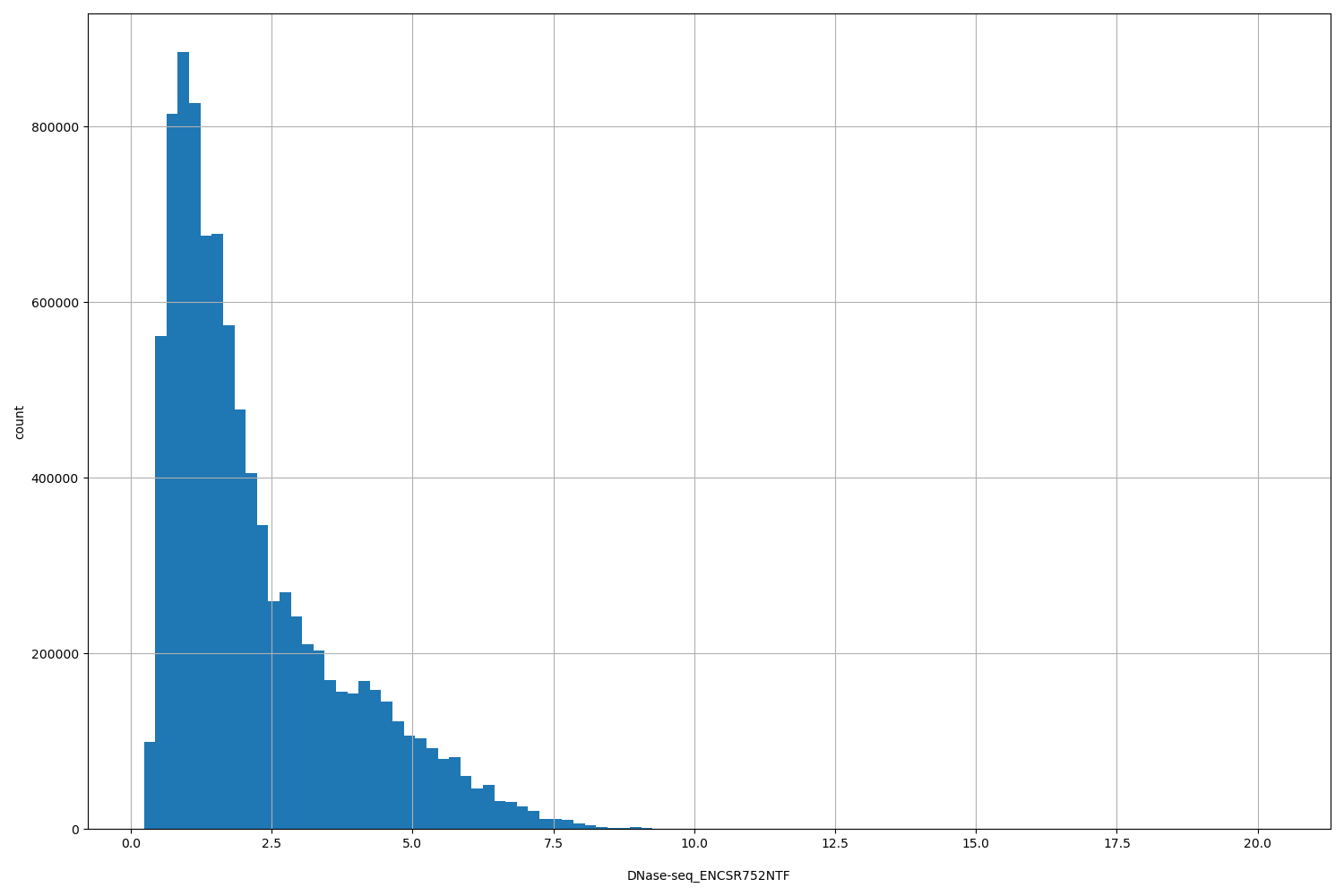 |
[0.235, 20.3] |
Files
| Filename | Size | md5 |
|---|---|---|
| ENCFF778TSG.bed.gz | 472.47 KB | 7d07cb23c9d708d6feb1ba3c05928964 |
| ENCFF778TSG.bed.gz.dvc | 100.0 B | 18c6505c1e337112ac886ea528954c4d |
| ENCFF778TSG.tabix.bed.gz | 432.08 KB | 4326b64de5cf62cbb03211c9c5d864ba |
| ENCFF778TSG.tabix.bed.gz.dvc | 106.0 B | a2523311abb935d6935492feade561cc |
| ENCFF778TSG.tabix.bed.gz.tbi | 243.27 KB | e38a3c8c4333fc6d25ae3bf59e9de654 |
| ENCFF778TSG.tabix.bed.gz.tbi.dvc | 110.0 B | cc7b90a6a43b5ee17fd7040400449d51 |
| genomic_resource.yaml | 2.68 KB | 5669f026b6c0ff7c18070f5abc4ba782 |
| statistics/ |