Resource
| Id | DNase-seq/ENCSR016THC |
|---|---|
| Type | position_score |
| Version | 0 |
| Summary |
DNase-seq ENCSR016THC [biosample_summary="Homo sapiens left renal pelvis tissue male embryo (105 days)"]
|
| Description |
status: released biological_replicates: Rep 1 summary: male embryo (105 days) output_type: peaks audit_warning: Alignment file {ENCFF728YQN|/files/ENCFF728YQN/} processed by DNase-seq ENCODE4 v3.0.0-alpha.2 GRCh38 pipeline ( {ENCPL848KLD|/pipelines/ENCPL848KLD/} ) for GRCh38 assembly has 27567783 mapped reads. According to ENCODE standards, conventional DNase-seq profile requires a minimum of 20 million uniquely mapped reads to generate a reliable SPOT (Signal Portion of Tags) score. The recommended value is > 50 million. For deep, foot-printing depth DNase-seq 150-200 million uniquely mapped reads are recommended. (See {ENCODE DNase-seq data standards|/data-standards/dnase-seq-encode4/}) audit_warning: Signal Portion of Tags (SPOT) is a measure of enrichment, analogous to the commonly used fraction of reads in peaks metric. ENCODE processed alignment files {ENCFF728YQN|/files/ENCFF728YQN/} processed by DNase-seq ENCODE4 v3.0.0-alpha.2 GRCh38 pipeline ({ENCPL848KLD|/pipelines/ENCPL848KLD/}) for GRCh38 assembly have a SPOT1 score of 0.38. According to ENCODE standards, SPOT1 score of 0.4 or higher is considered a product of high quality data. Any sample with a SPOT1 score <0.3 should be targeted for replacement with a higher quality sample, and a SPOT1 score of 0.25 is considered minimally acceptable SPOT1 score of 0.25 is considered minimally acceptable for rare and hard to find primary tissues. (See {ENCODE DNase-seq data standards|/data-standards/dnase-seq-encode4/}) |
| Labels |
|
Scores (1)
| ID | Type | Default annotation | Description | Histogram | Range |
|---|---|---|---|---|---|
| DNase-seq_ENCSR016THC | float |
DNase-seq_ENCSR016THC |
DNase-seq ENCSR016THC [biosample_summary="Homo sapiens left renal pelvis tissue male embryo (105 days)"]
|
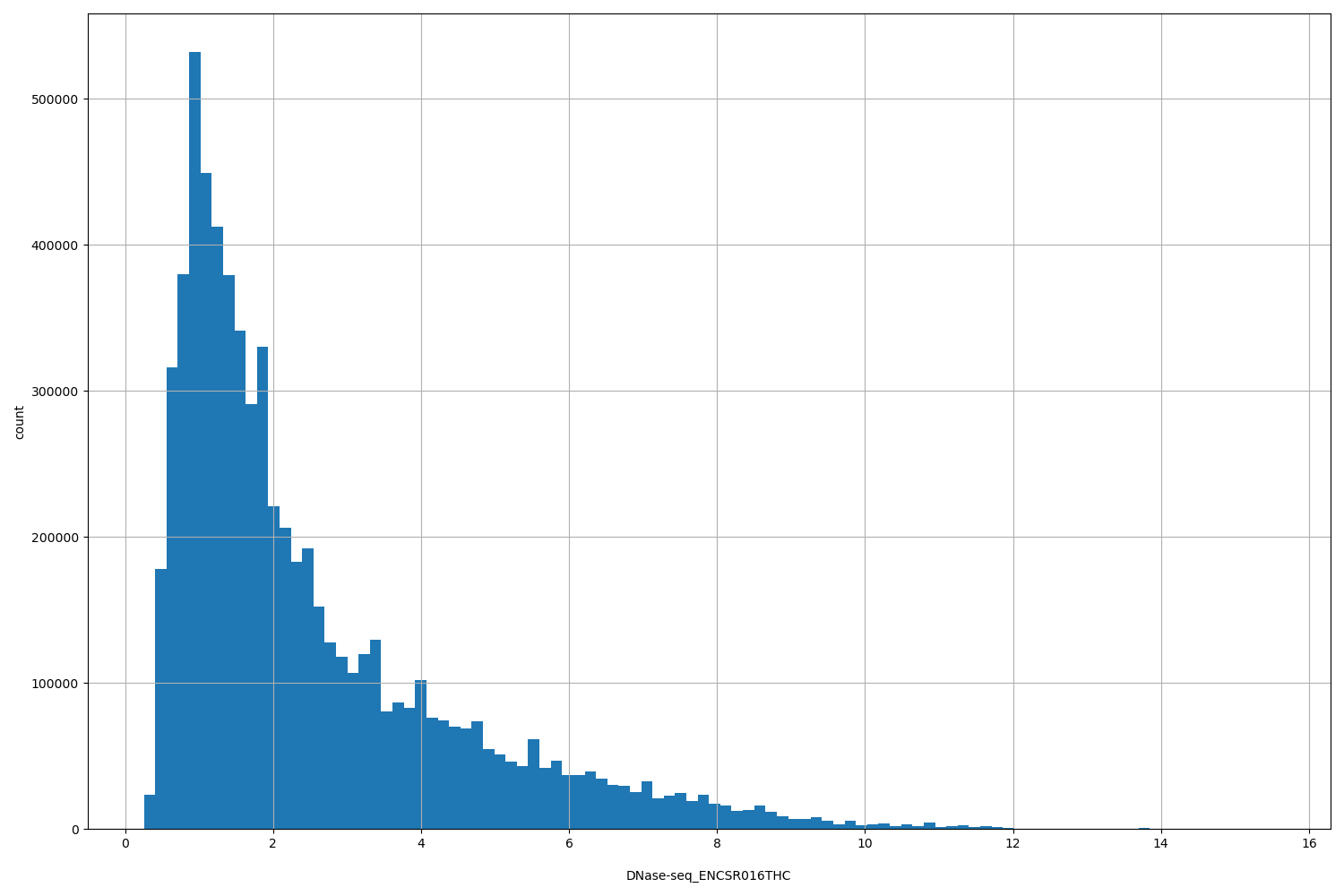 |
[0.255, 15.5] |
Files
| Filename | Size | md5 |
|---|---|---|
| ENCFF289MVB.bed.gz | 364.41 KB | 0ed6ed7e4060c24cae33564adc1dab18 |
| ENCFF289MVB.bed.gz.dvc | 100.0 B | 04fa75e383888d259c624ead93dcfc97 |
| ENCFF289MVB.tabix.bed.gz | 328.06 KB | f31d5eb55bd080f11684e58631afcb4c |
| ENCFF289MVB.tabix.bed.gz.dvc | 106.0 B | 87f6fa5939844f3b40354fc82cebe422 |
| ENCFF289MVB.tabix.bed.gz.tbi | 201.42 KB | aecf82df0698046eba3a850c3d023da2 |
| ENCFF289MVB.tabix.bed.gz.tbi.dvc | 110.0 B | 3431f170c5c9e4f6d6068ec7d900a3ab |
| genomic_resource.yaml | 2.67 KB | ccea3cc82b91344e9a5c0ab8b6c4eede |
| statistics/ |